
Introduction: What is a media effect model?
Hey there wonderful living things, welcome back to my second blog post! Now, before we dive in to discuss about the topic at hand – Media effects model (mostly what is wrong with it) and intriguing questions to ask about the role current media has in the shaping of mass opinion- I would like to extend my gratitude to everyone who has taken their time out to read my previous post. Okay… for those who did not read my previous post, in order to make things less awkward for you, I am going to move on to the main motive of this post.
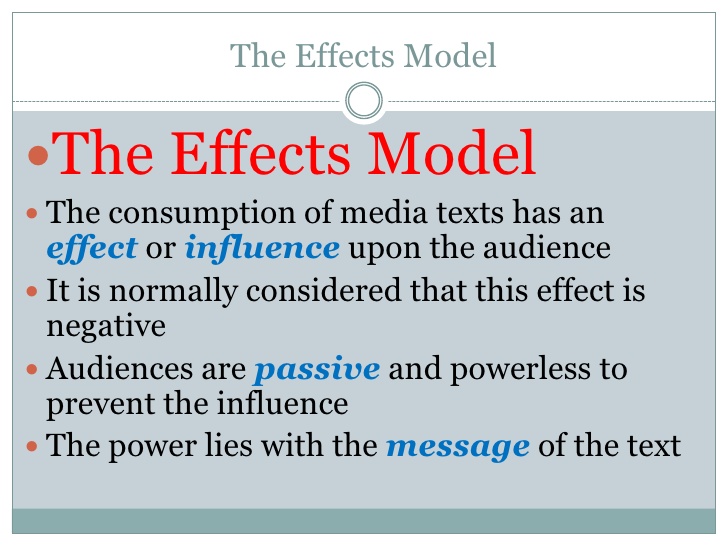
So, what is Media Effects Model all about? ‘Media effects’ explains through theories the influence of media over the attitude and perceptions of the viewers. Although most of the theories of ‘media effects’ model suggests that there is a negative impact on the audience member, many argue that the ‘media effects’ model is flawed fundamentally, thus the results are invalid.
Why media effects model is flawed?
So, what exactly is wrong with the Media Effects model? David Gauntlett discusses ten things that are wrong with the ‘effects model’ in an article from Approaches to Audience- A Reader. However, in this blog I am only going to discuss 3 of them as I feel that they are the most prominent flaws in the theory of Media Effects.
- 2.1) Effects model see young children as the ‘helpless’ targets:
Firstly, effects model studies tend to view children as being easily influential and gullible. More often than not, when a research is being conducted on children, researchers do not conduct a parallel study with the adults because it is considered a ‘common sense’ that they won’t act the same way and this highlights a very narrowminded approach. This problem is exposed by research which seeks to establish what children can and do understand about and from the mass media. The results of such projects have shown that children can talk intelligently and indeed cynically about the mass media, furthermore, children as young as seven are seen to make thoughtful, critical and media literate video productions themselves.

- 2.2) The effects model is often based on artificial studies.
Secondly, it is a known fact that sociological studies of media effects are time consuming and expensive, thus careful studies are often outnumbered by simpler studies which are characterized by artificial elements. Such studies are usually conducted in a laboratory or in a ‘classroom’ setting by researchers who instigates the activity; thus, it is impossible to classify the results as ‘natural’ reaction. To support this argument studies have demonstrated that the presence, appearance and gender of an observer can radically affect children’s behaviour.
Furthermore, the research subjects are shown abstracts and specially recorded videoclips – these contents lack narrative inherent meanings unlike the actual TV productions- thus, rendering the study invalid because, humans tend to rationalize the context in which an act is being demonstrated and just presenting them an out of context cue will just be perceived as a mere data. Researchers also do not consider the mental activity of the subjects at that particular time of test, so the results can be affected if the test subjects are not in the right state of mind.
- 2.3) Media effects is biased against violence
Lastly, the media effects model is infamous for being biased against ‘violence’ shown on Tele. I very much feel that, violence/anger is an innate character of humans. After all, there always has been wars, murders and other types of violence; domestic violence. And all of these have predated any forms of media. So, blaming media for personal traits just simply symbolizes us pointing fingers at someone else to blame for our wrong doings. Perhaps, here is a question that might intrigue your thoughts on media… what if people who actually have anger issues tend to watch violent TV content? Which leads us to perceive that the former is not a result of the latter but instead it is the other way around.
CONCLUSION
‘Oh my lord, we are finally reaching the end of this post’ is probably what that little inner voice is screaming in that exhausted brain of yours, but before I place my final full-stop of this post, I would like to dabble with a few questions. Media without doubt is a powerful platform that has been impacting its audience members. Now, the question is, can we really trust all that is shown on the media? We are without doubt influenced by details shown on the media that it shapes our very life, but we fail to see if the contents are reliable. For example the recent media has been blowing up about the CORONA VIRUS, but have we examined what the myths and facts are? Here is a fact or two for you to ponder on, the common flu kills 60 times more people annually than Corona and only 2% of cases have reported deaths and most of these deaths were associated with weaker immune systems( e.g old age). Which makes you wonder, what if the contents shown on the media are just abstracts, and their purpose is solely to boost the views for that particular programme? It is good to keep up with the daily happenings of the world, but do be mindful of what you are being fed. Thank you very much for your time ladies and gentlemen, have a wonderful time ahead! Ciao! Siva over and out!
 Siva's Thoughts